
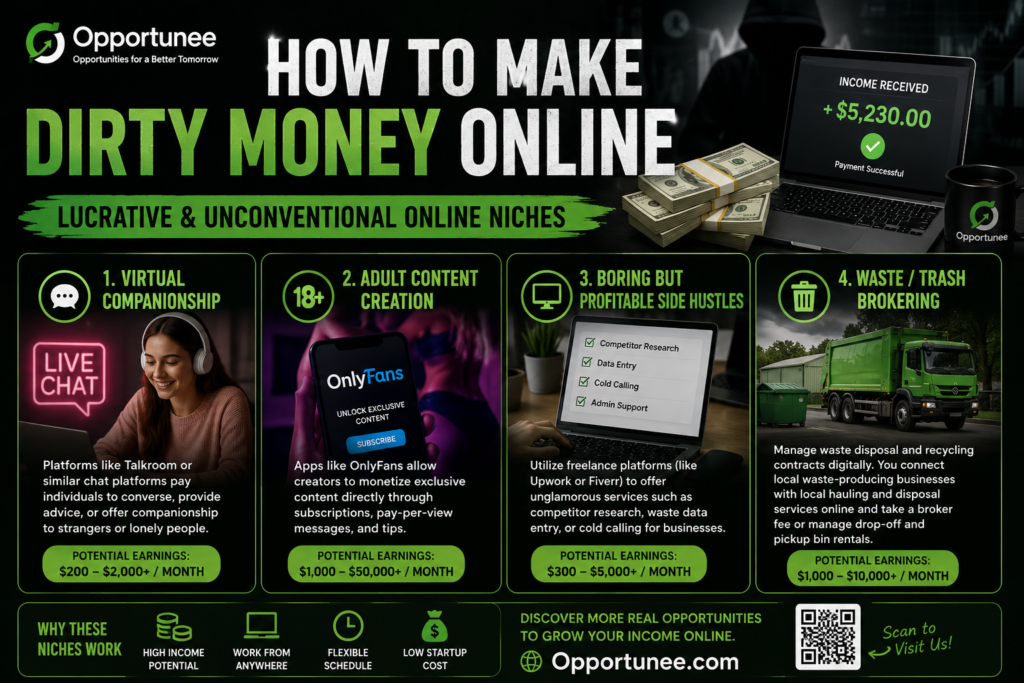
Introduction: If you are looking for “dirty” ways to make money online,then, the term usually may refer to highly lucrative but labor-intensive, unglamorous, or unconventional niches that most people avoid. These methods utilize the internet to find high-paying clients, source contracts, or build subscription audiences. here in opportunee, we will help you figure it out in a way that you can get the most out of it
The Uncomfortable Truth About “Dirty” Money Online
You see them everywhere. The posts. The videos. The promises. “Make $10,000 a month with this one weird trick! “And you know what? A small part of you wonders. Not because you’re naive, but because you’re human.
What if I told you there are ways to make real money online that most people ignore? Not because they’re illegal—they’re not. But because they feel uncomfortable, unglamorous, or just plain weird.
Let’s talk about them.
What “Dirty” Actually Means
The first thing you need to understand is that I’m not talking about doing anything illegal. The dark web is a whole different conversation—and a dangerous one, where the average age of cybercriminals is just 24, and where roles range from developers creating attack tools to money launderers and traffers . That’s not a path you want to go down.
Instead, I’m talking about unconventional money. The kind that makes your friends raise an eyebrow. The kind that requires a thick skin. The kind that people won’t be bragging about at dinner parties.
But here’s the secret: that’s exactly why it’s profitable.
The Virtual Companion Economy
Remember when relationships meant, well, people? That’s changing. A 2026 report from Research and Markets shows the AI girlfriend app market hit $2.32 billion in 2025 and is growing at 25.5% annually, projected to reach $7.15 billion by 2030 . The driver? Crippling loneliness.
Here’s what’s happening.
Platforms like Talkroom, OhChat, and Candy.ai are paying people to provide virtual companionship. Not necessarily anything explicit—sometimes it’s just conversation. Connection. A voice on the other end.
Candy.ai launched in late 2023 and reached $25 million in annual recurring revenue within its first year . Their pricing starts at $12.99 monthly, or about $72 annually—and they’ve got hundreds of thousands of paying users .
For creators, the economics are interesting. On OhChat, you can create an AI replica of yourself, and the platform handles the interactions. Creators keep 80% of earnings while the AI works around the clock . Carmen Electra and Katie Price are reportedly earning thousands per month from their digital counterparts .
Is it odd? Absolutely. Does it pay? Undeniably.
The OnlyFans Reality
Now, let’s address the elephant in the room.
OnlyFans. Adult content. It’s probably what you thought of when you read “dirty money.”
Here’s the reality that gets glossed over: it’s work. Hard work.
A study analyzing over 1 million subscribers found that messages drive 69.74% of revenue on OnlyFans, while subscriptions account for just 4.11% . The average creator makes approximately $1.79 for every message they send . For creators earning over $15,000 a month, the percentage from pay-per-view chats jumps to 65% .
What does this mean in practice? Long conversations. Constant interaction. Stars spend hours every week messaging fans, on top of planning and editing photoshoots . The average OnlyFans creator makes about $58,700 annually—around $5,000 per month . Veteran creators (5+ years) make around $74,000, with those who work full-time in the industry pulling in over $111,000 .
But here’s the real story: Only 0.1% of creators capture 76% of all earnings . Most creators work incredibly hard for modest returns. The ones who succeed treat it like a business.
The “Boring” Goldmine
This is the part that really gets me. While everyone chases get-rich-quick schemes, smart people are quietly building fortunes by doing the work no one else wants to do.
Freelancing: The $200,000 Story
Let me tell you about one freelancer’s journey. He started on Upwork out of boredom, delivering food on foot in Hong Kong just to kill time . His first freelance job paid $7. He did the work, got a 4/5 rating, and felt “unstoppable” .
Fast forward. He’s earned over $200,000 on the platform. His strategy? Simple:
- Apply only to clients from high-paying regions
- Target jobs with fewer than 5 proposals
- Log in when competition is asleep
- Focus on quality over quantity
- Build relationships—some clients started waiting for his availability rather than hiring someone else
Upwork’s data shows the fastest-growing skills include AI modeling, machine learning, data analytics, and marketing automation . But don’t overthink this. There’s huge demand for transcription, lead generation, email outreach, and other “boring” services that skilled freelancers can charge premium rates for .
Waste Brokering
Here’s one you probably never considered.
A startup called Big Scrapers has digitized the scrap trade in the Middle East and North Africa. Since 2023, they’ve served over 100,000 customers in Egypt alone and invested EGP300 million . Why? Because scrap trading has been stuck in the dark ages—operating through WhatsApp messages, phone calls, and informal networks .
The opportunity? Connect businesses that produce waste with businesses that need it. Act as the digital matchmaker for materials everyone else ignores. The textile recycling market alone is fragmented, opaque, and inefficient, with valuable materials often downcycled or incinerated because the right connections are missing . Platforms like Eslando have digitized over 30,000 tonnes of textile waste across recycling regions, enabling trade that previously happened through scattered messages and spreadsheets .
Could you do this locally? Absolutely. Every city has waste, and every city has businesses that need to get rid of it. The middleman who connects them digitally can earn a healthy fee.
Even Georgia-Pacific, a Fortune 500 company, launched a digital platform called hubbIT specifically to buy recyclable materials from smaller generators. In its first two years, the platform amassed 2,000 users and paid around $1.2 million for their waste, diverting 16 million pounds of recyclate from landfills . They saw a market inefficiency—and they capitalized on it.
The “Impossible” Reality Check
I want to pause here and share something important.
You’ll see videos claiming anyone can make $250,000 as an electrician working on AI data centers. Mike Rowe (yes, the Dirty Jobs guy) recently claimed some Gen Z electricians in Texas are making $240,000 to $280,000 annually . Here’s the reality: these are experienced professionals working on specialized projects in high-cost areas, with unlimited overtime. The median annual wage for firefighters is still under $60,000 . Electricians make good money, but the headline numbers are outliers.
The point isn’t that these opportunities don’t exist. It’s that they require specialized skills, real work, and patience. That’s the real “dirty” work.
So What Actually Works?
If you’re looking for an unconventional, “dirty” path that still feels ethical, consider:
Virtual companionship. If you’re good with people and thick-skinned about criticism, this can pay. Just know there’s a psychological cost.
Freelancing on “boring” tasks. The freelancer who made $200,000 on Upwork didn’t do anything glamorous. He did reliable, quality work and built relationships .
Waste brokering. There’s an entire industry built on what others throw away. The platforms exist. The demand exists. The middleman who connects supply with demand earns the fee.
Digital recycling platforms. The global textile recycling industry is fragmented, with transactions still happening through emails and informal networks . Platforms that digitize this process create massive value by reducing failed deals and improving recycling outcomes.
AI companionship platforms. The AI girlfriend market is projected to reach $7.15 billion by 2030 . Platforms need people willing to be the face (or voice) of these companions.
The Honest Truth
Here’s what nobody tells you about dirty money.
It’s not actually about the money. It’s about the willingness to do what others won’t. To face judgment. To work in spaces that feel uncomfortable. To stare down your own internal resistance and keep going anyway.
The freelancer who made $200,000 on Upwork started because he was bored. He didn’t plan to build a business. He just kept showing up, doing good work, and raising his rates .
The AI companionship market exists because loneliness is an epidemic. And for all the discomfort, providing connection—even artificial connection—has value .
The waste brokers are making money simply by connecting buyers and sellers in industries everyone else ignores. It’s not glamorous. It’s not Instagram-worthy. But it’s real.
And that’s the thing about “dirty” money. It’s often the most honest way to make a living.