
Introductions: The true wealth formula schools skipped is Wealth = (Income – Expenses) × (Time × Rate of Return). Wealth is built in the gap between what you earn and spend, and then multiplied exponentially through compound interest over time by investing in income-generating assets
The Core Wealth Drivers
- Expand the Gap: Avoid lifestyle creep. Every time your income grows, invest the difference rather than upgrading your expenses. [1]
- Buy Assets, Not Liabilities: Use your surplus to acquire assets that put money in your pocket (e.g., stocks, real estate, or your own business) rather than things that drain your cash (e.g., depreciating cars, excessive subscriptions). [1, 2, 3, 4]
- Leverage Compound Interest: The formula \(A = P(1 + r)^t\) (where A is the final amount, P is the principal, r is the interest rate, and t is time) shows how time is your greatest ally. Starting early matters more than the amount you start with.
- Invest in Yourself: Your ability to increase your active earning power through specialized skills and continuous education is an asset that yields the highest return. [1]
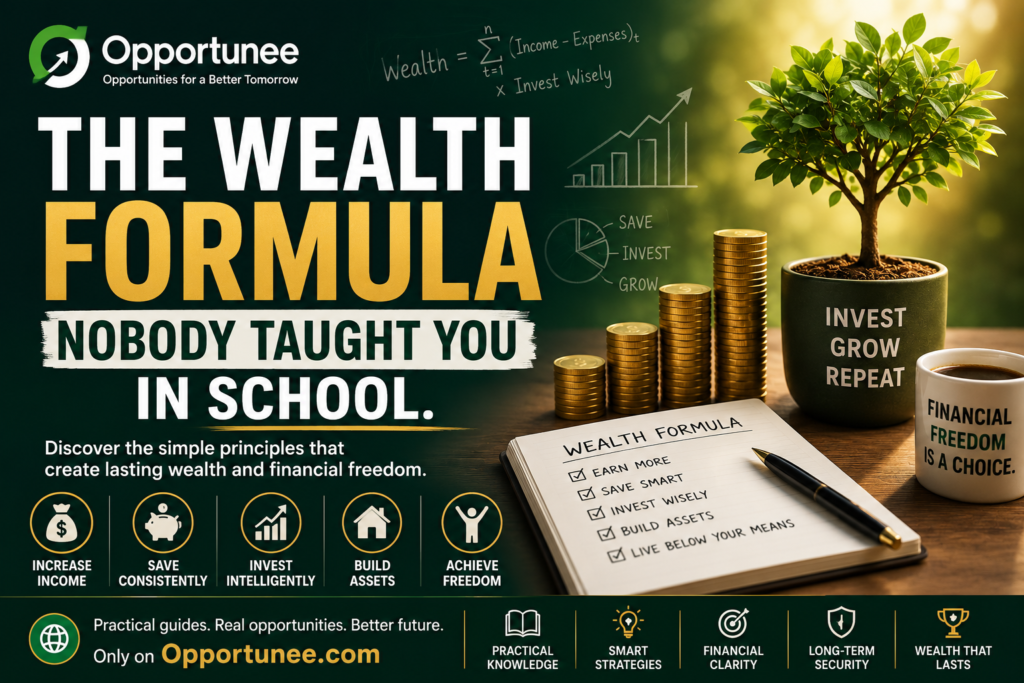
The Core Wealth Formula Explained
Why This Formula Changes Everything
Traditional financial advice focuses on one variable: Income. “Get a better job,” “ask for a raise,” “start a side hustle.” While increasing income is valuable, it is only one piece of the puzzle.
Consider this scenario:
- Person A earns $100,000 per year and spends $95,000. Their surplus is $5,000.
- Person B earns $60,000 per year and spends $40,000. Their surplus is $20,000.
Despite earning significantly less, Person B has four times the surplus to invest. Over time, Person B will build far more wealth than Person A, even though Person A has the higher income.
This is the power of the formula. Wealth is not determined by how much you earn—it is determined by how much you keep and how effectively you grow it.
The Two Sides of the Equation
The wealth formula has two distinct sides:
Side 1: (Income – Expenses) — The Surplus
This is your savings rate—the gap between what comes in and what goes out. A higher surplus means more fuel for wealth building. This is entirely within your control. You can increase income through career growth, side hustles, or business ventures. You can decrease expenses through mindful spending, eliminating waste, and avoiding lifestyle creep.
Side 2: (Time × Rate of Return) — The Multiplier
This is where compound interest works its magic. The longer your money is invested and the higher your rate of return, the faster your wealth grows. Time is the most powerful variable here—starting early matters far more than starting with a large amount.
Part 2: Expand the Gap (Avoid Lifestyle Creep)
What Is Lifestyle Creep?
Lifestyle creep—also called lifestyle inflation—occurs when your spending increases right alongside your rising salary . A $5,000 raise might feel substantial, but if it results in a new car lease, more expensive dinners, and a bigger apartment, your financial position has not actually improved.
The impulse is understandable. After working hard for a promotion, you feel you deserve nicer things. And that is true! But the problem is when luxuries become necessities . One 2025 Goldman Sachs report found that 40% of households earning $500,000 or more still felt like they were living paycheck to paycheck .
How Lifestyle Creep Sabotages Wealth
Lifestyle creep is dangerous because it is invisible. You do not notice it happening. It is:
- A slightly nicer apartment when your rent goes up anyway
- A newer car because the old one is “unreliable”
- More expensive groceries because you “deserve” better quality
- Dining out more often because you are “too tired” to cook
- Subscriptions that you never cancel because they are “only $9.99”
Each decision seems small on its own. But collectively, they eliminate your surplus. And without a surplus, you cannot invest.
The Psychology of Lifestyle Creep
Why do we fall into this trap? Psychology plays a significant role.
The Hedonic Treadmill: Humans adapt quickly to new circumstances. That new car feels exciting for a few weeks, then becomes normal. You need another upgrade to feel that same excitement again. This treadmill keeps you running faster but never reaching true satisfaction.
Social Comparison: We compare ourselves to our peers, neighbors, and social media influencers. When others upgrade their lives, we feel pressure to do the same. A 2024 study found that social media use is strongly correlated with increased spending, particularly on status-signaling items.
The “Deserve” Fallacy: We tell ourselves we have worked hard and “deserve” luxuries. This is true in moderation, but it becomes a justification for unlimited spending.
How to Defeat Lifestyle Creep
1. Automate Your Savings First
Set up automatic transfers to investment accounts on payday. Treat your investments like a non-negotiable bill—pay your future self before you have a chance to spend the money.
2. Adopt the “50/30/20” Framework
Allocate 50% of your income to needs, 30% to wants, and 20% to savings and investments. This ensures surplus while still allowing for enjoyment.
3. Pause Before Upgrading
When you get a raise, wait 90 days before making any lifestyle changes. This pause allows the excitement to fade, so you can make rational decisions.
4. Ask “What Does This Cost My Future?”
Instead of asking “Can I afford this?” ask “What is the opportunity cost?” A $500 monthly car payment might seem affordable, but invested at 8% over 20 years, it becomes over $285,000 .
5. Focus on Freedom, Not Status
Shift your mindset from “I deserve this” to “What does this cost my future?” Remind yourself that true freedom comes from ownership, not consumption.
Part 3: Buy Assets, Not Liabilities
Understanding the Difference
Once you have a surplus, the next step is deciding where it goes. To build lasting wealth, you must use your surplus to acquire assets—things that put money in your pocket—rather than liabilities, which drain it.
As Robert Kiyosaki famously explains, assets put money in your pocket, and liabilities take money out . A rental property that generates monthly income is an asset. A car that requires payments, insurance, and maintenance is a liability.
The Asset-Liability Trap
A common trap is spending on depreciating items like fancy cars, the latest gadgets, or excessive subscriptions. These might feel like rewards, but they do not generate income. They cost you money, and they lose value over time.
Consider a $50,000 car purchase. If you invest that $50,000 instead, at an 8% average annual return over 20 years, it grows to over $233,000 . The car, by contrast, is worth perhaps $15,000 after five years . The decision is not just about money—it is about opportunity.
Examples of Assets That Generate Wealth
Income-Generating Assets:
- Dividend-paying stocks: Companies that distribute profits to shareholders quarterly or annually
- Real estate: Rental properties that produce monthly cash flow and appreciate over time
- Bonds: Government or corporate debt that pays regular interest
- REITs: Real estate investment trusts that pay dividends without you needing to be a landlord
- Digital products: E-books, courses, and software that sell repeatedly with no inventory costs
- Businesses: Companies that generate profit and can be operated by others
Examples of Liabilities:
- Depreciating vehicles with loans and maintenance costs
- Consumer electronics that lose value rapidly
- Subscription services that charge monthly but do not add value
- Unused memberships and storage units
- Luxury clothing and accessories that do not appreciate
The Wealthy Mindset Shift
As financial experts explain, the goal is to get your money working for you. Investments generate cash flow. They put money in your pocket every month or quarter, and they have the potential to appreciate. This is the engine that builds generational income.
The rich buy assets. The middle class buys liabilities they think are assets. This is the fundamental difference between those who build wealth and those who simply earn an income.
Part 4: Leverage Compound Interest (The Eighth Wonder of the World)
What Is Compound Interest?
Compound interest is the process of earning interest not only on your initial investment but on the accumulated interest from previous periods. This creates a snowball effect—small amounts grow exponentially over time.
The formula is:
A = P(1 + r)^t
Where:
- A is the final amount
- P is the principal (your initial investment)
- r is the annual rate of return (expressed as a decimal)
- t is the time in years
The Math of Compounding
Consider two people:
- Alex invests $5,000 per year from age 25 to 35 (10 years total, $50,000 invested), then stops entirely.
- Bailey invests $5,000 per year from age 35 to 65 (30 years total, $150,000 invested).
Assuming an 8% average annual return, at age 65:
- Alex’s $50,000 grows to approximately $680,000
- Bailey’s $150,000 grows to approximately $566,000
Alex invested only one-third as much money but has more wealth.
That is the power of time.
The Rule of 72
The Rule of 72 is a quick way to estimate how long it takes your money to double. Simply divide 72 by your annual return:
| Annual Return | Years to Double |
|---|---|
| 4% | 18 years |
| 6% | 12 years |
| 8% | 9 years |
| 10% | 7.2 years |
| 12% | 6 years |
At a 12% return, your money doubles every six years. In 30 years, $10,000 becomes over $160,000—without any additional contributions.
Real-World Examples of Compounding
Example 1: Retirement Savings
A 25-year-old who invests $200 per month at a 10% average return will have approximately $1.1 million by age 65. A 35-year-old who invests $400 per month for the same 30 years will have just over $800,000—even though they invested twice as much each month.
Example 2: Kenyan Government Bonds
Kenya’s Treasury Bonds currently offer 11-14% annual returns paid semi-annually . A KES 1,000,000 investment at 12% would grow to over KES 17,000,000 in 25 years—without any additional deposits .
Example 3: Dividend Reinvestment
Investing $10,000 in a dividend-paying stock with a 3% yield and 7% annual growth would be worth over $76,000 after 30 years with dividends reinvested—even before factoring in dividend growth.
Why Starting Early Matters More Than Starting Large
The mathematical lesson is clear:
Time is more valuable than money.
You cannot get time back. Starting at 25 gives you 40 years of compounding before retirement. Starting at 35 gives you only 30 years. Those 10 extra years are worth far more than the additional contributions you could make later.
A 2024 study by Vanguard analyzed millions of retirement accounts and found that the single most important factor in wealth accumulation was the number of years of consistent investing, not the amount invested.
Part 5: Invest in Yourself (The Highest-Yield Asset)
Why You Are Your Best Investment
While financial assets are crucial, they require capital. The most powerful asset you can build, especially when you are starting out, is you.
As Warren Buffett explains, “The best thing you can do is to be exceptionally good at something. Whatever abilities you have can’t be taken away from you. They can’t actually be inflated away from you” . He calls developing yourself “the best investment by far” because it is not taxed and cannot be inflated away.
Your ability to increase your active earning power through specialized skills and education is the foundation of everything. It drives the “Income” part of the formula and creates the surplus needed to invest.
What Investing in Yourself Looks Like
1. Skill Development
Focus on high-value skills that command premium rates:
- Technical skills: Programming, data analysis, AI/ML, cybersecurity
- Financial skills: Investing, accounting, financial modeling
- Communication skills: Writing, public speaking, negotiation
- Management skills: Leadership, project management, team building
- Creative skills: Design, content creation, marketing
2. Knowledge Acquisition
Read voraciously in your field and beyond. Take courses, attend conferences, and find mentors. The best investors are lifelong learners.
3. Physical and Mental Health
Your earning capacity depends on your health. Exercise, proper nutrition, and stress management are investments in your productivity and longevity.
4. Network Building
Your network is your net worth. Cultivate relationships with people in your industry, potential mentors, and collaborators. Opportunities come through people.
5. Certification and Credentials
In many fields, additional certifications directly increase earning potential. An MBA, CPA, or technical certification can add thousands to your annual income.
The Return on Investing in Yourself
Consider these examples:
- A graphic designer who invests $500 in learning advanced UI/UX design can increase their rates from $50/hour to $100/hour. The $500 investment pays for itself within 10 hours of work.
- A corporate employee who spends $1,000 on a project management certification can earn an average of $5,000 more annually. In just one year, that’s a 500% return.
- An aspiring entrepreneur who invests in a business coach can accelerate their learning curve by months or years, potentially adding tens of thousands in revenue.
As Codie Sanchez puts it, if you have limited cash, “the best returning asset class of all time is going to be you” . Before betting on the stock market, you should bet on yourself.
Part 6: Putting It All Together
The Practical Application
The wealth formula works as a system:
- Increase Income: Develop skills, advance your career, start a side hustle, or build a business.
- Control Expenses: Avoid lifestyle creep, eliminate waste, and focus on value rather than status.
- Invest the Difference: Direct surplus into income-generating assets that compound over time.
- Give It Time: Be patient and consistent. Wealth is built slowly and then suddenly.
Real-World Example
Consider Sarah, a 28-year-old in Nairobi:
Year 1:
- Annual Income: KES 1,200,000 (approximately $9,200)
- Annual Expenses: KES 720,000
- Surplus: KES 480,000
- Investment: KES 480,000 in a diversified portfolio averaging 10% annual return
- Net Worth After Year 1: KES 528,000
Year 10:
- Annual Income: KES 2,400,000 (career growth)
- Annual Expenses: KES 1,080,000 (moderate lifestyle increase)
- Surplus: KES 1,320,000
- Cumulative Investments at 10% return: Over KES 12,500,000
Year 25 (Age 53):
- Surplus continues to grow with career progression
- Cumulative Investments: Over KES 50,000,000
- Passive income from investments: Over KES 5,000,000 annually
- Financial independence achieved
This is not magic. It is math.
Common Objections Addressed
“I don’t earn enough to invest.”
Start small. Even $50 per month at 10% over 30 years grows to over $100,000. The amount matters far less than the habit of investing consistently.
“The market is too risky.”
Diversification reduces risk. Global equities, government bonds, and REITs have historically returned positive yields over long periods. Time in the market beats timing the market.
“I’m too old to start.”
Any time is better than never. Yes, starting at 25 is better than starting at 45. But starting at 45 is better than starting at 55. As the saying goes: “The best time to plant a tree was 20 years ago. The second best time is now.”
Part 7: The Mindset Shift
From Consumer to Creator
Most people think of themselves as consumers. They earn money, spend it on goods and services, and repeat the cycle. Wealth requires a fundamental shift:
Think of yourself as a creator. Your income is your raw material. Your savings are your investments. Your wealth is your creation.
From Short-Term to Long-Term
The financial world is noisy. Stock prices fluctuate, headlines scream crisis, and social media showcases wealth that seems impossible. Tune it out.
Wealth is built over decades, not days. Warren Buffett is not a billionaire because of one brilliant trade. He is a billionaire because he started investing at age 11 and has been compounding for 80 years.
From Fear to Discipline
Investing requires discipline. It means investing when markets are falling, staying the course when everyone else is panicking, and automatically contributing month after month. The discipline is the strategy.
From “I Deserve” to “I Choose”
Replace “I deserve this” with “I choose my future.” Every expense is a choice. Choose wisely.
Conclusion: Your Next Steps
The formula is simple, but execution requires discipline. Here is how you can put it into action today:
1. Audit Your Lifestyle
Identify where lifestyle creep might be shrinking your gap. Track your spending for one month and categorize every expense. What adds value? What is merely habit?
2. Automate Your Savings
Set up automatic transfers to investment accounts on payday. Treat your investments like a non-negotiable bill. Pay yourself first, before you have a chance to spend the money.
3. Buy Assets
Research and invest in income-generating assets. Start with accessible options like dividend stocks, money market funds, or REITs. Gradually expand to real estate and business ownership.
4. Invest in Your Skills
Dedicate time each week to learning. Read books, take courses, and practice high-value skills. Your knowledge compounds just like your money.
5. Give It Time
Be patient. Wealth is not built overnight. But with consistent effort, the compounding effect is unstoppable.
The Formula in Action
Wealth is built in the gap between what you earn and what you spend, and then multiplied exponentially over time.
Start closing that gap. Start giving your money time to grow. Every day you wait is a day of compounding potential lost. The wealth formula works—but only for those who put it into action.
Your future self will thank you.
This article is for informational purposes only and does not constitute financial advice. Consult a qualified financial advisor for personalized guidance.