Introduction:
Budgeting on an irregular income requires building a “survival budget” based on your lowest-earning months. You then use high-earning months to fund savings, buffer accounts, and seasonal costs. For comprehensive guides on adapting these frameworks, check NerdWallet’s Budgeting Guide and Investopedia’s Budgeting Strategies. [1, 2, 3, 4]
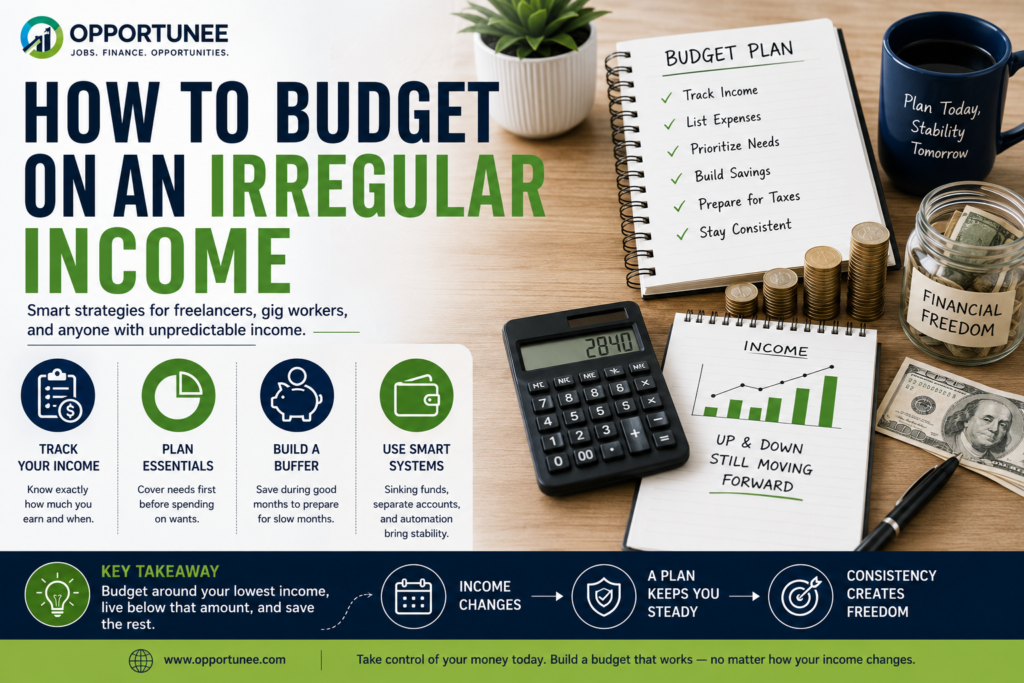
How to Budget on an Irregular Income
Budgeting is relatively straightforward when you receive the same paycheck every month. You know exactly how much money is coming in, making it easier to plan your spending, save for the future, and pay your bills on time.
But for millions of people—including freelancers, gig workers, commission-based salespeople, small business owners, seasonal employees, and contract workers—income can vary significantly from one month to the next. One month may bring more work than you can handle, while the next may be unusually quiet.
This uncertainty often leads to financial stress, missed savings goals, and difficulty managing expenses. The good news is that budgeting on an irregular income is entirely possible with the right system.
Instead of relying on a fixed paycheck, you’ll create a flexible budget that prioritizes essential expenses, prepares for slower months, and helps you build long-term financial security.
This guide explains how to budget effectively even when your income changes every month.
Who Needs an Irregular Income Budget?
An irregular income budget is ideal for anyone whose earnings fluctuate.
Examples include:
- Freelancers
- Self-employed professionals
- Business owners
- Seasonal workers
- Real estate agents
- Ride-share drivers
- Delivery drivers
- Commission-based salespeople
- Content creators
- Consultants
- Online entrepreneurs
- Agricultural workers
- Construction workers paid by projects
If your monthly income isn’t predictable, traditional budgeting methods may not work well.
Why Traditional Budgets Often Fail
Most budgeting advice assumes your income stays the same each month.
For example:
Monthly Income
- $3,000
Monthly Expenses
- Rent
- Food
- Utilities
- Transport
- Savings
- Entertainment
That approach works well for salaried employees.
However, if your monthly income looks like this:
- January – $4,200
- February – $2,100
- March – $5,300
- April – $2,900
A fixed budget quickly becomes unrealistic.
Instead, your budget needs flexibility.
Step 1: Calculate Your Minimum Monthly Living Expenses
Before creating any budget, determine the absolute minimum amount you need every month.
Include only essential expenses.
Housing
- Rent or mortgage
- Property taxes (if applicable)
Utilities
- Electricity
- Water
- Internet
- Phone
Food
- Groceries
- Basic household supplies
Transportation
- Fuel
- Public transport
- Vehicle insurance
- Essential maintenance
Insurance
- Health insurance
- Vehicle insurance
- Home insurance
Debt
- Minimum loan payments
- Credit card minimums
Avoid including luxury spending at this stage.
Your goal is to identify your Financial Survival Number.
For example:
| Expense | Monthly Cost |
|---|---|
| Rent | $800 |
| Food | $350 |
| Utilities | $180 |
| Transport | $220 |
| Insurance | $150 |
| Debt Payments | $300 |
Total Essential Expenses = $2,000
This becomes your budgeting foundation.
Step 2: Base Your Budget on Your Lowest Expected Income
One of the biggest mistakes people make is budgeting according to their best month.
Instead, budget using your lowest realistic monthly income.
Suppose your income over six months looked like this:
- $2,400
- $3,600
- $2,900
- $5,100
- $2,700
- $4,300
Instead of budgeting around $4,000, build your budget around approximately $2,500.
If you earn more than expected, that’s excellent—you can save or invest the difference.
If you earn less than expected, your budget is already designed to handle it.
This approach creates stability.
Step 3: Separate Needs from Wants
When income varies, knowing the difference between essential and discretionary spending becomes even more important.
Needs
These are expenses that keep your life running.
Examples include:
- Housing
- Utilities
- Groceries
- Transportation
- Insurance
- Healthcare
- Minimum debt payments
These should always come first.
Wants
These improve your lifestyle but aren’t essential.
Examples include:
- Streaming services
- Dining out
- Vacations
- Entertainment
- Shopping
- Premium subscriptions
- Luxury purchases
During lower-income months, these expenses are the easiest to reduce temporarily.
Step 4: Build a Buffer Fund
A buffer fund is different from an emergency fund.
An emergency fund is designed for unexpected events like job loss, medical expenses, or major repairs.
A buffer fund helps smooth out normal income fluctuations.
Imagine this scenario:
Month One
Income: $5,000
Expenses: $3,000
Instead of spending the extra $2,000, transfer it into a separate savings account.
Month Two
Income: $2,100
Expenses: $3,000
Withdraw $900 from your buffer fund.
Your lifestyle stays consistent even though your income changed.
Many financial planners recommend working toward one to three months of essential expenses as a starting buffer.
Step 5: Prioritize Bills in the Right Order
When money is tight, pay bills based on importance rather than due dates alone.
A practical order is:
- Housing
- Utilities
- Food
- Transportation
- Insurance
- Minimum debt payments
- Savings
- Lifestyle expenses
This ensures your basic needs are covered before discretionary spending.
Step 6: Pay Yourself First
One of the most effective financial habits is saving before spending.
Even if your income changes every month, commit to saving a percentage of every payment you receive.
For example:
- Save 10% of every invoice.
- Save 15% of every commission.
- Invest 20% of unusually high-income months.
Automating transfers into a savings or investment account can make this easier and reduce the temptation to spend.
Step 7: Use Separate Bank Accounts
Mixing all your money into one account can make it difficult to know what is available for bills, savings, or taxes.
Consider separating your finances into dedicated accounts, such as:
- Income account
- Bills account
- Emergency fund
- Savings or investments
- Tax account (especially for freelancers and self-employed workers)
This simple system can improve organization and reduce accidental overspending.
The Common Budgeting Mistakes to Avoid
When income is unpredictable, a few common mistakes can quickly create financial pressure:
- Spending based on your highest earning month.
- Ignoring irregular annual expenses.
- Not saving during high-income periods.
- Treating every extra payment as disposable income.
- Relying on credit cards to cover income gaps.
- Failing to review your budget regularly.
Avoiding these habits can make your finances more resilient, even when your income varies.
Step 8: Create Sinking Funds for Future Expenses
One reason many people with irregular incomes struggle financially is that they forget about expenses that don’t occur every month.
These may include:
- Car insurance
- Vehicle servicing
- School fees
- Property taxes
- Annual subscriptions
- Holiday travel
- Home maintenance
- Medical expenses
- Birthday and holiday gifts
Instead of scrambling when these bills arrive, create sinking funds.
A sinking fund is money you save gradually for a specific purpose.
For example:
| Expense | Annual Cost | Save Each Month |
|---|---|---|
| Car Insurance | $600 | $50 |
| Holiday Gifts | $480 | $40 |
| Vehicle Maintenance | $720 | $60 |
| School Supplies | $360 | $30 |
Saving a little every month makes large expenses much easier to manage.
Step 9: Budget Every Time You Get Paid
If you’re paid weekly, biweekly, or after completing projects, don’t wait until the end of the month to plan.
Instead, create a mini-budget each time money arrives.
Ask yourself:
- Which bills are due next?
- How much should I save?
- Do I need to buy groceries?
- Can I make an extra debt payment?
- Can I invest part of this payment?
This approach gives you better control over your cash flow.
Step 10: Increase Your Income During Slow Months
Budgeting alone won’t solve every financial challenge.
If your income drops significantly during certain periods, consider ways to supplement it.
Ideas include:
- Freelance work
- Online tutoring
- Virtual assistance
- Selling digital products
- Affiliate marketing
- Pet sitting
- Food delivery
- Consulting
- Seasonal jobs
- Selling unused items
Even a modest side income can help cover essential expenses during slower months.
Budgeting Methods That Work Well for Irregular Income
No single budgeting method fits everyone, but these approaches tend to work particularly well when your income varies.
1. Zero-Based Budget
Every dollar has a specific purpose.
Income minus expenses should equal zero—not because you spend everything, but because every dollar is assigned to bills, savings, debt repayment, or investments.
Best for:
- Freelancers
- Business owners
- Self-employed professionals
2. Priority-Based Budget
Instead of assigning every dollar immediately, you focus on paying expenses in order of importance.
Typical priority order:
- Housing
- Food
- Utilities
- Transportation
- Insurance
- Debt
- Savings
- Lifestyle spending
This method works well when monthly income is unpredictable.
3. Percentage Budget
Rather than fixed amounts, allocate percentages.
Example:
- 50% Needs
- 20% Savings
- 20% Wants
- 10% Debt or Extra Savings
When income increases or decreases, the percentages remain consistent.
Review Your Budget Every Month
An irregular-income budget isn’t something you create once and forget.
Set aside time every month to review:
- Total income received
- Essential spending
- Savings progress
- Debt balances
- Upcoming expenses
- Investment contributions
Regular reviews help you adjust before small issues become larger financial problems.
A Simple Monthly Budget Checklist
Use this checklist at the beginning of every month.
☐ Estimate your minimum expected income.
☐ List all essential bills.
☐ Schedule debt payments.
☐ Transfer money into savings.
☐ Add to your emergency fund.
☐ Fund your sinking funds.
☐ Plan discretionary spending.
☐ Review last month’s expenses.
☐ Update your financial goals.
Keeping this routine simple makes it easier to stay consistent.
Example Budget for an Irregular Income
Sarah is a freelance graphic designer.
Her average monthly income ranges from $2,800 to $4,500.
She bases her budget on $2,800, her lowest expected monthly income.
Monthly Essentials
- Rent: $900
- Utilities: $180
- Groceries: $350
- Transportation: $220
- Insurance: $150
- Debt: $250
Total Essentials: $2,050
The remaining $750 is allocated to:
- Emergency fund
- Retirement investing
- Sinking funds
- Personal spending
When Sarah earns $4,500, she doesn’t immediately increase her lifestyle. Instead, she:
- Adds more to savings.
- Makes extra debt payments.
- Invests additional funds.
- Expands her financial buffer.
This strategy allows her to maintain stability during slower months.
Best Budgeting Apps for Irregular Income
Digital tools can simplify budgeting by helping you track spending, monitor savings, and stay organized.
Popular options include:
- YNAB (You Need A Budget) – Designed around assigning every dollar a job, making it useful for variable income.
- EveryDollar – Supports zero-based budgeting with a simple interface.
- Monarch Money – Comprehensive budgeting and financial planning features.
- PocketGuard – Helps identify how much you can safely spend after bills and savings.
- Google Sheets or Microsoft Excel – Flexible and free for people who prefer to build a custom budget.
Choose a system you’ll actually use consistently.
Frequently Asked Questions
How much should I save if my income changes every month?
Rather than aiming for a fixed amount, consider saving a percentage of every payment you receive. This keeps saving consistent regardless of income fluctuations.
Should I budget using my average income?
It’s generally safer to budget using your lowest realistic monthly income. Any additional earnings can strengthen your savings, investments, or emergency fund.
How large should my emergency fund be?
Many financial experts recommend saving three to six months of essential living expenses. If your income is highly unpredictable, building a larger emergency fund may provide additional security.
What if I have no income one month?
If possible, use your financial buffer or emergency fund to cover essential expenses while reducing discretionary spending. Having multiple income sources can also reduce the impact of slow periods.
Hence,
Living with an irregular income doesn’t mean you have to live with financial uncertainty. The key is to build a budget that adapts to changing earnings instead of relying on a fixed paycheck.
By identifying your essential expenses, budgeting around your lowest expected income, building a financial buffer, and saving consistently during higher-income months, you can create stability even when your earnings fluctuate. Over time, these habits reduce stress, improve cash flow, and make it easier to achieve long-term goals such as paying off debt, investing, or building wealth.
The most effective budget isn’t the most complicated one—it’s the one you can follow consistently. Small, disciplined decisions made month after month can have a significant impact on your financial future.