
The common mistake of many borrowers is to take the very first loan offer they have got or just to pay attention to the monthly payment only. The wrong choice of loan offer can cost you several hundreds or thousands of dollars. Getting the knowledge on how to compare loan offers like a professional will help you to avoid expensive mistakes.
This guide contains all the factors that a professional should consider while advising someone to choose one loan offer rather than another.
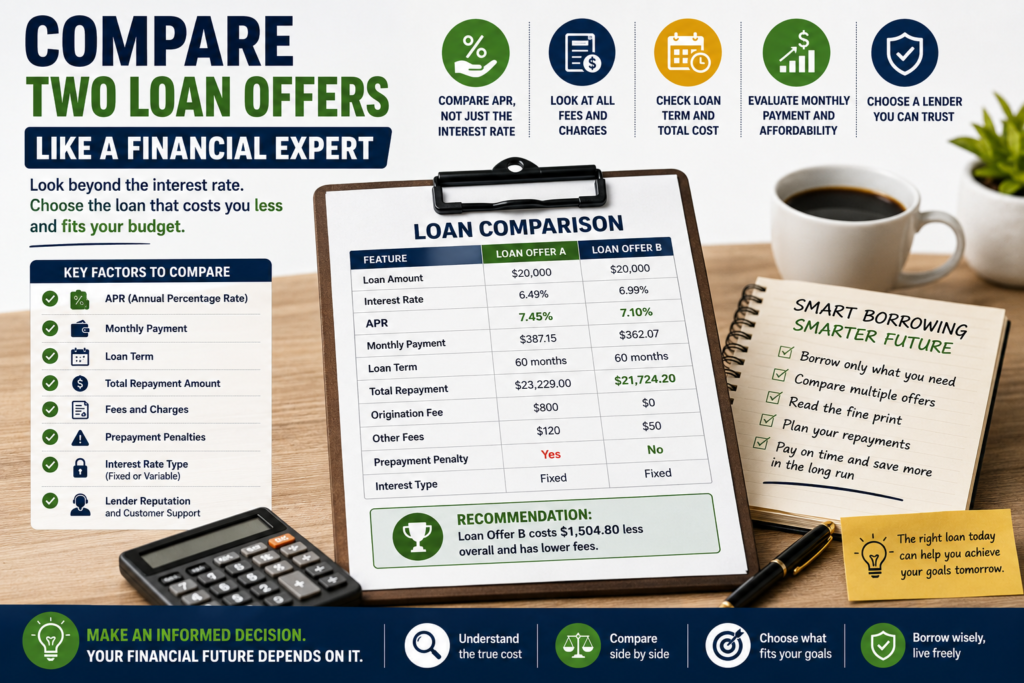
Why it’s important to compare loan offers
Loan offers seem alike on their face value. You might be offered the same amount of money by two different creditors; however, the true price of borrowing could be greatly different from each.
For instance, one creditor may offer a low interest rate while charging high origination fees. The second one would have a bit higher interest rate but would not ask you to pay any fee at all.
Comparing them will help you:
Lower the total cost of borrowing;
Avoid additional costs;
Obtain manageable monthly payments;
Pick a loan term matching your budget;
Borrow more confidently.
In fact, the point is not to choose the lowest-priced loan offer, but rather to get the best deal.
Start by Comparing the Loan Amount
Before comparing interest rates or repayment terms, make sure both offers are based on the same loan amount.
If one lender approves you for $20,000 and another approves you for $18,000, comparing monthly payments alone won’t give you an accurate picture.
Ask yourself:
- Are both lenders offering the amount I actually need?
- Am I borrowing more than necessary?
- Will accepting a larger loan increase my interest costs?
Borrowing only what you need helps reduce the amount of interest you’ll pay over time.
Compare the Annual Percentage Rate (APR), Not Just the Interest Rate
One of the biggest mistakes borrowers make is comparing only interest rates.
While the interest rate shows what you’ll pay for borrowing money, the Annual Percentage Rate (APR) gives a more complete picture because it includes the interest rate plus certain lender fees.
Consider these two examples:
| Loan Offer | Interest Rate | APR |
|---|---|---|
| Lender A | 6.5% | 7.8% |
| Lender B | 6.9% | 7.1% |
Although Lender A advertises the lower interest rate, Lender B actually has the lower APR, meaning it could cost less overall.
Whenever you’re comparing similar loan products, the APR is often one of the most useful numbers to evaluate.
Look Beyond the Monthly Payment
A lower monthly payment can seem attractive, especially if you’re working with a tight budget.
However, lower payments often result from extending the repayment period.
For example:
- Loan A: $350 per month for 3 years
- Loan B: $240 per month for 6 years
Loan B may appear more affordable each month, but you’ll likely pay much more in total interest because you’re borrowing the money for twice as long.
Always compare:
- Monthly payment
- Repayment period
- Total amount repaid
Looking at all three together gives you a much clearer understanding of each offer.
Compare the Total Cost of the Loan
Professional financial advisers don’t stop at the monthly payment—they calculate the total amount the borrower will repay.
The total loan cost includes:
- Principal
- Interest
- Origination fees
- Administrative charges
- Other applicable lender fees
A loan with a slightly higher monthly payment may actually save you money if it significantly reduces your total repayment.
Whenever possible, ask each lender for the estimated total repayment amount before making your decision.
Review Every Fee Carefully
Some loan costs aren’t immediately obvious.
Common fees include:
- Origination fees
- Application fees
- Processing fees
- Documentation fees
- Late payment fees
- Returned payment charges
- Prepayment penalties (where applicable)
Even relatively small fees can increase the true cost of borrowing.
Review the loan agreement carefully and ask the lender to explain any fee you don’t understand.
Compare Fixed and Variable Interest Rates
Not every loan charges interest the same way.
A fixed interest rate remains the same throughout the loan, giving you predictable monthly payments that are easier to budget for.
A variable interest rate can change over time based on market conditions. While it may start lower than a fixed rate, it can increase later, raising your monthly payments.
If you value payment stability, a fixed-rate loan may be the better choice. If you’re comfortable with some uncertainty and understand the risks, a variable-rate loan could be worth considering.
Evaluate the Loan Term Carefully
The repayment period affects both your monthly payment and the total amount you’ll repay.
A shorter loan term generally means:
- Higher monthly payments
- Lower overall interest costs
- Faster debt repayment
A longer loan term usually provides:
- Lower monthly payments
- Greater budgeting flexibility
- Higher total interest paid
The best option depends on your financial situation. Choose a repayment period that keeps your payments affordable without unnecessarily increasing the total cost of borrowing.
Consider the Lender’s Reputation and Customer Support
The loan itself is important, but so is the company providing it.
A lender with transparent policies, responsive customer service, and a strong reputation can make borrowing much easier if questions or financial challenges arise later.
Before choosing a lender, take time to research:
- Customer reviews from trusted platforms.
- How quickly the lender responds to inquiries.
- Whether loan terms are explained clearly.
- The lender’s complaint resolution process.
- Available support channels, such as phone, email, or live chat.
A slightly cheaper loan may not be worth it if the lender has a history of poor customer service or unclear lending practices.
Check Whether You Can Repay the Loan Early
Many borrowers hope to pay off their loan ahead of schedule if their financial situation improves.
Before signing a loan agreement, find out:
- Can you make additional payments without restrictions?
- Does the lender charge a prepayment penalty?
- Will extra payments reduce the principal balance immediately?
- Will paying early reduce the total interest you owe?
Some lenders encourage early repayment, while others charge penalties that reduce the financial benefit. Understanding these policies can help you save money if you decide to pay off the loan sooner.
Look for Flexible Repayment Options
Life doesn’t always go according to plan. A job change, medical emergency, or unexpected expense could make loan payments more difficult.
Some lenders offer features that provide extra flexibility, such as:
- The ability to change your payment date.
- Temporary hardship assistance.
- Payment deferral programs for eligible borrowers.
- Online account management and automatic payments.
- Multiple payment methods.
These options may not seem important when you first take out the loan, but they can become valuable if your circumstances change.
Compare the Loan Offers Side by Side
Rather than relying on memory, organize the information in a simple comparison table.
| Feature | Loan Offer A | Loan Offer B |
|---|---|---|
| Loan amount | ||
| Interest rate | ||
| APR | ||
| Monthly payment | ||
| Loan term | ||
| Total repayment | ||
| Origination fee | ||
| Late payment fee | ||
| Prepayment penalty | ||
| Fixed or variable rate | ||
| Customer reviews |
Completing a table like this makes it much easier to identify which loan provides the better overall value.
Ask These Questions Before Making Your Decision
Financial experts rarely make decisions based on a single number. Instead, they evaluate how the loan fits the borrower’s overall financial picture.
Before choosing between two offers, ask yourself:
- Which loan will cost less over its entire repayment period?
- Can I comfortably afford the monthly payment?
- Does one lender charge significantly more fees?
- Is the repayment term appropriate for my financial goals?
- Would I benefit from paying the loan off early?
- Which lender has clearer terms and better customer support?
If one offer consistently provides better answers to these questions, it’s likely the stronger choice.
Common Mistakes to Avoid When Comparing Loan Offers
Even careful borrowers sometimes overlook important details. Avoid these common mistakes when reviewing loan offers.
Choosing the Lowest Interest Rate Without Looking at the APR
A lower interest rate doesn’t always mean a less expensive loan. The APR includes certain fees, making it a more complete measure of borrowing costs.
Focusing Only on Monthly Payments
Affordable monthly payments are important, but they shouldn’t be your only consideration.
A lower payment spread over many years may result in paying much more interest overall.
Ignoring Loan Fees
Application fees, origination fees, administrative charges, and late payment penalties all affect the total cost of borrowing.
Always calculate the complete cost—not just the advertised rate.
Overlooking Loan Flexibility
Repayment flexibility, hardship options, and early repayment policies can make a significant difference if your financial circumstances change.
Accepting the First Offer
Receiving a loan approval is encouraging, but it doesn’t necessarily mean you’ve found the best deal.
Comparing several offers can help you identify lower costs and more favorable terms.
Tips for Comparing Loan Offers Like a Financial Expert
Professional financial advisers often follow a simple process when evaluating loans:
- Compare the APR before the interest rate.
- Calculate the total repayment amount.
- Review every fee listed in the loan agreement.
- Consider whether the monthly payment fits comfortably within your budget.
- Check if the loan allows early repayment without penalties.
- Research the lender’s reputation.
- Read the loan disclosure carefully before signing.
Following these steps can help you make a more informed borrowing decision.
Frequently Asked Questions
What is the most important factor when comparing two loan offers?
There isn’t a single factor that determines the best loan. Instead, compare the APR, total repayment amount, fees, monthly payment, loan term, and lender reputation to understand the overall value of each offer.
Is the loan with the lowest monthly payment always the best?
No. A lower monthly payment often results from a longer repayment period, which may increase the total interest paid over the life of the loan.
Why is the APR more useful than the interest rate?
The APR reflects both the interest rate and certain loan fees, making it a better measure of the overall cost of borrowing.
Should I choose a shorter repayment term?
If you can comfortably afford the higher monthly payments, a shorter loan term often reduces the total interest paid. However, it’s important to choose a repayment schedule that fits your budget and financial goals.
How many loan offers should I compare?
Comparing at least three loan offers can provide a better understanding of current market rates and help you identify the most competitive option.
Conclusion:
Comparing two loan offers like a financial expert isn’t about finding the lowest advertised interest rate—it’s about understanding the complete cost of borrowing and choosing the option that best supports your financial goals.
Take time to compare the APR, fees, repayment term, monthly payment, and total amount you’ll repay. Consider the lender’s reputation, customer support, and repayment flexibility alongside the numbers. A loan that looks slightly more expensive at first glance may actually provide better long-term value once all costs and features are considered.
The more informed your decision, the more likely you’ll choose a loan that fits your budget, minimizes unnecessary costs, and helps you achieve your financial goals with confidence.