
Introduction: The most common borrowing mistakes include borrowing for consumption, failing to read repayment terms, and borrowing blindly during a crisis. People often make these errors when they rush or feel peer pressure. [1, 2] We can make it clear at Opportunee that; Borrowing money can solve today’s problem or create a financial burden for tomorrow. Learn about the borrowing mistakes that almost everybody makes at least once and how to avoid costly debt.
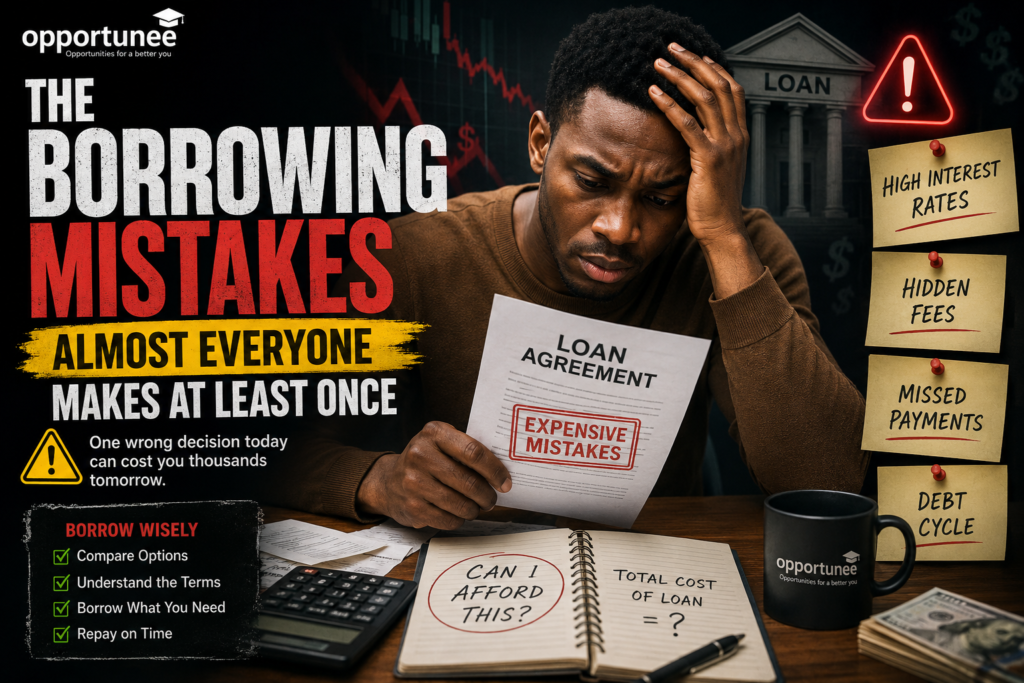
Top Borrowing Errors
- Consuming with debt: Taking loans for food, clothes, or travel instead of investments.
- Ignoring the total cost: Forgetting to check hidden fees, interest rates, and extra penalties.
- Impulse borrowing in a panic: Grabbing the first quick loan you see during an emergency without comparing lenders.
- Borrowing for status: Getting into debt just to impress friends or match a social lifestyle.
- Skipping a repayment plan: Borrowing money without knowing where the cash to pay it back will come from. [1, 2, 3, 4, 5]
1. Borrowing Without Defining Exactly Why You Need the Money
Every loan should have a clear purpose. Yet many people borrow simply because they qualify or because the money is readily available.
Before applying for any loan, ask yourself one simple question:
“What problem is this loan solving?”
If you can’t answer that question clearly, you may be borrowing for the wrong reasons.
Borrowing to pay unexpected medical bills, finance education, or invest in a business opportunity can be reasonable because these expenses often have long-term value. Borrowing to fund impulse purchases, expensive holidays, or lifestyle upgrades is far riskier because you’ll still be repaying the loan long after the excitement has faded.
A clear borrowing purpose also helps you determine how much money you actually need.
Ask yourself
- Is this a necessity or a want?
- Can I delay this purchase and save instead?
- Is borrowing the cheapest solution?
- Will this expense improve my financial situation or make it worse?
Why this mistake is costly
Borrowing without a clear purpose often leads to:
- Spending money on non-essential purchases.
- Borrowing more than necessary.
- Paying interest on items that quickly lose value.
- Taking longer to achieve important financial goals.
Key takeaway: Don’t borrow because money is available. Borrow because it solves a genuine financial need.
2. Choosing the First Loan Instead of Comparing Your Options
When money is urgently needed, it’s easy to accept the first loan offer you receive. Unfortunately, convenience can be expensive.
Lenders don’t all charge the same interest rates or fees. They also differ in repayment flexibility, customer service, penalties, and eligibility requirements. Even a small difference in interest rates can save—or cost—you hundreds or thousands of dollars over the life of a loan.
Before signing any agreement, compare multiple lenders instead of focusing only on how quickly you can receive the money.
Compare these factors
✔ Interest rate
✔ Annual Percentage Rate (APR), if available
✔ Loan processing fees
✔ Late payment penalties
✔ Early repayment charges
✔ Repayment period
✔ Total repayment amount
✔ Customer reviews and lender reputation
Don’t forget to check whether the lender is licensed or regulated in your country. This simple step can help you avoid fraudulent lenders and unfair lending practices.
A common mistake
Many borrowers compare only the monthly repayment amount. However, a lower monthly payment often means a longer repayment period, resulting in more interest paid over time.
Always compare the total cost of the loan, not just the monthly installment.
Key takeaway: The best loan isn’t necessarily the fastest—it’s the one that costs you the least while meeting your financial needs.
3. Borrowing More Than You Actually Need
Being approved for a larger loan can feel reassuring. You may think it’s better to have extra money available “just in case.”
In reality, accepting more money than you need usually means paying interest on money that isn’t providing meaningful value.
Suppose you need $8,000 for home repairs, but the lender offers $12,000. Taking the additional $4,000 simply because it’s available increases both your monthly repayments and the total interest you’ll pay.
That extra money can also encourage unnecessary spending, making it even harder to repay the loan.
Before accepting a larger loan, ask yourself
- What will every dollar be used for?
- Can I complete my goal with a smaller loan?
- Is the extra borrowing worth the additional interest?
Borrow only what you need today—not what you’re tempted to spend tomorrow.
Why this matters
Borrowing more than necessary can lead to:
- Higher monthly repayments.
- Increased interest costs.
- Longer repayment periods.
- Greater financial pressure during emergencies.
Key takeaway: Your borrowing limit is not a recommendation. It’s simply the maximum amount a lender is willing to offer.
4. Looking Only at the Monthly Payment Instead of the Total Cost
One of the easiest ways to underestimate the cost of a loan is by focusing solely on the monthly payment.
A lower monthly installment may seem attractive, but it doesn’t necessarily mean the loan is cheaper. In many cases, lenders reduce monthly payments by extending the repayment period. While this makes the loan appear more affordable, it often results in paying much more interest over time.
Instead of asking, “How much do I pay each month?”, ask:
- How much interest will I pay overall?
- What is the total repayment amount?
- Are there any hidden charges?
- Can I repay the loan early without penalties?
Understanding the total borrowing cost helps you compare loans fairly and avoid paying more than necessary.
Costs that borrowers often overlook
- Processing fees.
- Administrative charges.
- Insurance premiums.
- Late payment penalties.
- Annual account fees.
- Early settlement fees.
These expenses can significantly increase the actual cost of borrowing.
Key takeaway: Always compare loans using the total repayment amount, not just the monthly payment.
5. Signing the Loan Agreement Without Reading the Fine Print
Many borrowers spend hours researching a new phone or car but only a few minutes reading a loan agreement that could affect their finances for years.
That’s a mistake.
Loan agreements explain your rights, responsibilities, and the lender’s terms. Skipping the fine print could leave you unaware of important conditions that increase the cost of borrowing or limit your options later.
Pay close attention to
- Interest rate structure (fixed or variable).
- Repayment schedule.
- Late payment penalties.
- Default consequences.
- Early repayment rules.
- Additional fees.
- Conditions for changing loan terms.
If you don’t understand a clause, ask questions before signing.
A reputable lender should explain every term clearly. If you’re pressured into signing immediately or discouraged from reading the agreement, consider it a warning sign.
Key takeaway: Never sign a loan agreement you don’t fully understand.
6. Assuming Your Future Income Will Solve Today’s Loan
One of the most dangerous assumptions borrowers make is believing that future income will automatically make loan repayments easier.
You might expect:
- A salary increase.
- A promotion.
- Better business profits.
- Overtime pay.
- Annual bonuses.
- Higher investment returns.
While these things may happen, none of them are guaranteed.
Life is unpredictable. Unexpected expenses, inflation, illness, job loss, or economic downturns can reduce your income instead of increasing it.
When deciding whether to borrow, base your calculations on the income you earn today—not the income you hope to earn next year.
A safer approach is to ask yourself:
“If my income stayed exactly the same for the next 12 months, could I comfortably repay this loan?”
If the answer is no, reconsider the loan amount or postpone borrowing until your financial position improves.
Remember: Borrow based on your current financial reality, not your future expectations.
7. Using One Loan to Repay Another Without Fixing the Root Cause
Replacing one loan with another isn’t always a bad idea. Debt consolidation or refinancing can reduce your interest rate and simplify repayments when done for the right reasons. The mistake is taking out a new loan simply to avoid paying an existing one while the underlying financial problem remains unchanged.
For example, if you use a personal loan to clear a credit card balance but continue spending beyond your means, you’ll soon have both the personal loan and a new credit card balance to repay.
Warning signs you’re falling into a debt cycle
- You borrow every month to cover previous loan repayments.
- Most of your income goes toward debt payments.
- You’re using one credit facility to pay another.
- You keep extending loan terms to reduce monthly payments.
- You’re relying on payday or short-term loans to stay afloat.
Instead of borrowing again, identify what’s causing the problem. It could be overspending, irregular income, poor budgeting, or an emergency that requires a different financial solution.
Key takeaway: A new loan should improve your financial position—not postpone an existing problem.
8. Ignoring Your Credit Score and Credit History
Many people only think about their credit score when a lender rejects their application. By then, the damage may already be done.
Your credit history tells lenders how you’ve managed debt in the past. A strong repayment record can improve your chances of qualifying for better interest rates and higher borrowing limits. On the other hand, missed payments, loan defaults, or excessive borrowing may make future loans more expensive or harder to obtain.
Habits that can hurt your credit
- Missing repayment deadlines.
- Paying less than the required amount.
- Applying for several loans within a short period.
- Defaulting on previous loans.
- Carrying high debt balances for long periods.
Habits that help build a healthy credit profile
✔ Pay every loan on time.
✔ Borrow only when necessary.
✔ Keep debt manageable.
✔ Check your credit report regularly if it’s available in your country.
Key takeaway: Every loan you take affects your financial reputation. Protect it by borrowing responsibly.
9. Falling for Loan Offers That Sound Too Good to Be True
Scammers know that people looking for loans are often under financial pressure. That’s why fraudulent loan offers usually promise things legitimate lenders cannot.
Be cautious if a lender claims to offer:
- Guaranteed approval regardless of your financial situation.
- Extremely low interest rates with no explanation.
- Large loans without verifying your identity or income.
- Instant approval after paying an upfront fee.
These are common warning signs of loan scams.
Before accepting any loan offer
- Verify that the lender is licensed or regulated.
- Read independent customer reviews.
- Visit the lender’s official website.
- Never pay an upfront fee simply to receive a loan.
- Avoid sharing sensitive personal information with unverified lenders.
If something feels rushed or unrealistic, take a step back. A legitimate lender should give you enough time to review the loan terms before you make a decision.
Key takeaway: If a loan sounds too good to be true, it probably is.
10. Missing Repayment Dates
Missing a loan payment doesn’t just result in late fees—it can affect your credit history, increase the total cost of borrowing, and reduce your chances of qualifying for future loans.
Many missed payments happen because borrowers lose track of due dates rather than because they lack the money to pay.
Make repayments easier by:
- Setting reminders on your phone.
- Using calendar alerts.
- Enrolling in automatic payments if appropriate.
- Paying a few days before the due date instead of waiting until the last minute.
If you think you’ll miss a payment, contact your lender as early as possible. Some lenders may offer temporary payment arrangements or other options before the account falls into default.
Key takeaway: Paying on time is one of the simplest ways to reduce borrowing costs and maintain a good credit history.
11. Borrowing Under Pressure
Financial decisions made under pressure are rarely the best ones.
You might feel pressured because:
- Friends encourage you to “take advantage” of a loan offer.
- Family expects you to contribute to an expense.
- A salesperson says the offer expires today.
- Social media creates pressure to keep up with other people’s lifestyles.
Loans should support your financial goals—not someone else’s expectations.
Whenever possible, take time to compare lenders, read the agreement, and think through the long-term impact before committing.
Remember, a genuine financial opportunity will still make sense after you’ve had time to consider it.
Key takeaway: Never let urgency or pressure replace careful financial planning.
12. Waiting Too Long to Ask for Help
Many borrowers avoid contacting their lender when they begin experiencing repayment difficulties. They hope their financial situation will improve before the next payment is due.
Unfortunately, delaying the conversation often makes the problem worse.
If you’re struggling to repay a loan:
- Contact your lender immediately.
- Explain your situation honestly.
- Ask whether hardship assistance is available.
- Discuss revised repayment options if necessary.
Many lenders are more willing to help borrowers who communicate early than those who simply stop making payments.
Seeking help isn’t a sign of financial failure—it’s often the first step toward preventing a manageable problem from becoming a serious one.
Key takeaway: The earlier you act, the more options you’re likely to have.
Borrowing Checklist: Ask Yourself These Questions Before Applying
Before you sign any loan agreement, go through this checklist:
✔ Do I really need this loan?
✔ Have I compared multiple lenders?
✔ Do I understand the total cost of borrowing?
✔ Can I comfortably afford the repayments?
✔ Have I read and understood the loan agreement?
✔ Am I borrowing only what I need?
✔ Do I have a backup plan if my income changes?
✔ Is the lender legitimate and properly regulated?
If you answer “no” to any of these questions, take more time before borrowing.
In Conclusion:
Borrowing money isn’t something to fear—it’s something to approach carefully. The right loan can help you achieve important goals, manage unexpected expenses, or invest in your future. The wrong loan, or the wrong borrowing decisions, can leave you paying for today’s choices long into the future.
The best borrowers aren’t those who qualify for the largest loans. They’re the ones who understand the costs, borrow only what they need, make repayments on time, and choose credit that fits their financial situation.
Before signing your next loan agreement, slow down, compare your options, and ask the right questions. A few extra minutes of research today could save you months—or even years—of unnecessary financial stress.