Introduction: Borrowing money can be a useful financial tool when used responsibly, but the amount you receive is rarely the amount you ultimately repay. The true cost of borrowing includes interest, fees, repayment schedules, penalties, and other charges that can significantly increase the total amount you owe. Understanding these costs before signing a loan agreement can help you make informed financial decisions, avoid unnecessary debt, and protect your long-term financial health.
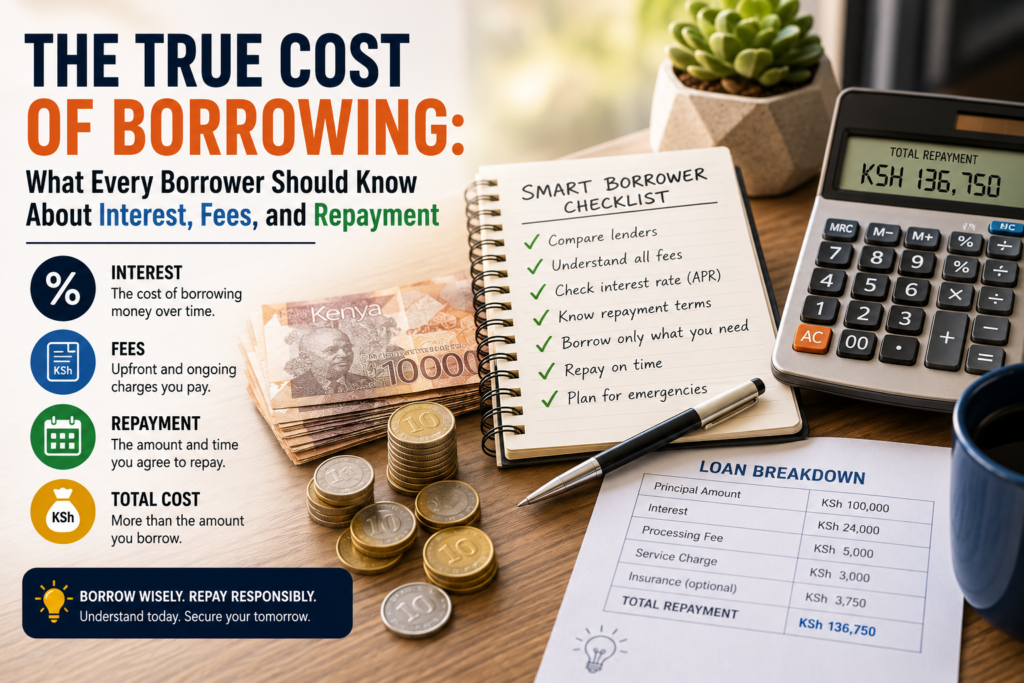
Whether you’re considering a mobile loan, personal loan, SACCO loan, bank loan, or digital credit, knowing how lenders calculate borrowing costs is just as important as knowing how much you need. This guide explains the real cost of borrowing, breaks down common loan charges, and provides practical tips to help you borrow wisely.
What Does the True Cost of Borrowing Mean?
True cost of borrowing means the extra amount of money that you have to pay besides what you borrowed.
For instance, if you borrow KSh 50,000, you might think that you will be required to pay back KSh 50,000. However, you will most likely pay more since lending institutions will require you to pay for their services.
These can include the following:
Interest
Charges
Service fee
Facility fee
Insurance (where necessary)
Late payment penalty
The actual costs vary depending on the lending institution and the kind of loan.
One of the biggest financial blunders that borrowers tend to commit is only looking at how much money they are borrowing.
Interest Explained
It is the cost paid by the lending firm in terms of a percentage for using the funds.
Consider it the price of borrowing money.
The longer it will take for you to pay back a loan, the more interest you will be required to pay, depending on the structure of the loan.
Interest is always represented as a percentage.
For instance:
Borrowed amount: KSh 100,000
Interest rate: 12% p.a.
The amount of money that you will have to pay back depends on things like:
Term of the loan
Type of interest (whether reducing balance or flat interest)
Fees
Frequency of payment
Remember to inquire on how the interest is computed before taking up any loan.
Simple Interest vs. Reducing Balance
All loans do not compute the interest using the same approach.
Flat or Simple Interest
When flat interest is involved, the interest is calculated from the original loan amount all through the repayment period.
This ends up being more costly in terms of borrowing.
Reducing Balance Interest
The case of reducing balance interest is where the interest is computed on the outstanding loan balance.
When you pay off some of the principal amount borrowed, there will be lesser interest to pay.
It is preferred by most people due to the reduced costs in the long run.
Processing Fees
Lenders may also levy a processing fee for evaluating your loan application.
This fee may be;
A fixed amount
A percentage of the loan amount
This is a fee that may be charged before you get the money you apply for.
In case you get approval for Ksh 20,000 but a processing fee is charged before disbursal, the amount received by you might be less than the amount approved while repaying as per the terms of the loan agreement.
Always ask whether;
There is any processing fee
Whether the processing fee is refundable
Whether it is charged before disbursing the loan
Facilities and Services Charges
Some loan agreements have additional administrative fees.
They include;
Account maintenance
Loan administration
System usage
Documentation
These charges vary widely among different lenders.
You can never assume that two similar loans will be the same even when the interests rates are the same.
Charges on top of the interest rate can add considerably to the total repayment amount.
Late Payments Penalties
In case you delay to repay after the agreed due date, you can attract extra charges.
Depending on the lending institution, these may include;
Penalty charges
Extra interest rate
Administrative charges
Late payments may affect future borrowing possibilities with that lender.
The best way of avoiding penalties is to repay on time or even before the agreed due date.
If you foresee trouble in meeting the repayment deadlines, contact your lender at the earliest possible time.
Why the Lowest Interest Rate Is Not Necessarily the Cheapest Loan
Many people consider the lowest interest rate when seeking a loan.
This is understandable but it is wrong.
For instance;
Loan A
Low interest rate
High processing fee
Service charge every month
Loan B
Slightly high interest rate
No processing fee
No service charges
The loan which has a low interest rate may be more costly than the other.
The total repayment amount is more important than the rate of interest.
Why You Should Understand the APR
The Annual Percentage Rate (APR) gives you a bigger picture of the borrowing costs since it may include interest and some of the fees.
APR makes comparison of loans easy across different lending institutions.
It is important to note that different lending companies present the borrowing costs differently, so be careful.
Always read the loan agreement and ask questions when in doubt.
Why Loan Terms Are Important
The term of the loan affects the total cost of borrowing.
Short Term Loans
Advantages
They are repaid faster
Lower total interest charges in most cases
Debts are cleared quickly
Disadvantages
Higher repayments on a monthly basis
Long Term Loans
Advantages
Lower repayments every month
Easy to manage the cash flow
Disadvantages
There will be accumulation of more interests
Loan will be outstanding for long
Choosing the right repayment term depends on your income and budget.
Borrow Only What You Need
The easiest way of reducing borrowing costs is by borrowing less.
People may be tempted to borrow the maximum amount possible from the lending institution especially if they are pre-approved.
However,
Just because you are pre-approved does not mean you should borrow the maximum amount.
Every additional shilling increases the total interest and repayment obligation.
Borrow according to your need, not availability.
Read the Loan Agreement Carefully
Many people ignore the terms and conditions in the loan agreement.
The terms and conditions give you all the information on;
Interest calculation
Fees
Repayment schedule
Consequences of default
Early settlement terms and charges
Understanding the loan terms saves you from surprises in the future.
Always read and understand the loan agreement before signing or accepting the loan.
Early Repayment and Its Effects
Some lenders allow you to repay your loans early.
Under certain circumstances, early repayment can do the following;
Reduce future interest costs
Reduce the period of repayment
Give you more financial freedom
Note that some of the loans have early settlement conditions and charges.
Common Borrowing Mistakes
Many financial difficulties start way before repayment starts.
Avoid the following common mistakes.
Borrowing Without Repayment Plans
Never assume you will find ways of repaying later on.
Have a clear plan on how to repay before accepting the loan.
Ignoring Hidden Fees
Always ask for every fee that applies to the loan.
Asking questions is free but ignorance is expensive.
Taking Multiple Loans
It becomes more challenging to repay many loans at once.
Various repayment dates, various lending institutions and different repayment amounts become too difficult to keep track.
In such cases, try to avoid multiple borrowing.
Using Loans to Buy Luxuries
When you borrow to finance luxuries, you create long term financial difficulties for yourself.
The best time to borrow is when;
There are emergencies
Funding educational requirements
Investing in business with reasonable income potential
Essential house requirements
Planned purchases with the capacity to repay them
Questions to Ask Before Taking a Loan
Before borrowing any loan, ask yourself;
How much total will I repay?
What is the rate of interest?
Are there any other fees besides interest?
What will happen if I delay in repayment?
Can I comfortably afford the repayments?
Is there a cheaper alternative?
Do I need that loan?
If you cannot answer confidently, stop before you borrow the loan.
Smart Ways of Reducing Borrowing Cost
You cannot completely avoid borrowing but you can reduce its cost.
Effective ways include;
Comparing several lenders
Reading the loan agreement carefully
Borrowing only what you need
Repaying on time
Avoiding penalty charges
Making extra payments where allowed
Building an emergency savings fund to reduce future borrowing
Simple decisions before borrowing can save you considerable amount of money.
When Borrowing Makes Financial Sense
Borrowing is not necessarily bad.
In some situations, borrowing is a good financial choice.
Some examples include;
To repay any medical expense
Funding educational purposes
Investing in a business with realistic income potential
Financing necessary home improvements
Covering temporary cash flow gaps as long as the repayment is feasible
The key is ensuring the loan solves your problems without creating a bigger one.
Warning Signs of Borrowing Too Much
You are overreaching yourself if;
You borrow frequently before payday.
You depend on one loan to repay another
Your major income is going into debt
You have trouble covering your living expenses after repayments
You are stressed whenever repayment dates come close
Identifying the warning signs in advance allows you to change your financial behavior before debt overwhelms you.
Frequently Asked Questions
What is the largest cost of borrowing?
For most loans, the interest rate is the largest cost. But, fees, penalties and service charges may significantly increase the total cost of repayment.
Is Lower Interest Rate Better Than Higher?
Not necessarily. A loan with lower interest rate and higher fees may end up being more expensive than a loan with higher interest rate and fewer fees.
Can I Negotiate Loan Terms?
Some lenders may agree to discuss certain terms depending on the loan especially the large loans. It is up to the lender and the loan terms.
Why Should I Compare Lenders?
Comparison of lenders helps you to understand the difference in the interest rates, fees, repayment period and loan terms.
Final Thoughts
Borrowing can be very useful financially when done responsibly but the amount borrowed is just the tip of the iceberg. The true cost of borrowing includes interests, fees, repayment terms and financial commitments until you pay back the loan. Understanding the cost of borrowing beyond the advertised loan amount helps you make smart decisions and avoid unnecessary financial strains.
When accepting any loan, make sure to understand all the charges involved, compare different lenders, calculate the total repayment and know what to borrow and how much. Borrow only what you need and that fits comfortably within your budget, do not use credit for financing the daily luxury expenses. Responsible borrowing starts before borrowing.
With wise handling, loans can help you achieve your financial objectives without straining your future. Through understanding how borrowing costs works and planning the repayments well, you can make use of loans as a tool for finance rather than letting debt becoming a burden.
Disclaimer: The above article is for informational purposes only and should not be taken as a professional financial advice. Loan products, fees, interest rates, and loan terms differ between lenders. Always review the terms and conditions of any loan product before borrowing.